By clicking "Subscribe", you confirm that you have read and accepted our Terms and Conditions, Privacy Policy and Cookie Policy.
Public libraries are evolving. Increasingly, they are expanding beyond their walls to create dynamic outdoor spaces that support programming, enhance visitor experience and strengthen community connections.
The Clinton Macomb Public Library is one of many forward-thinking institutions leading this transformation. As part of its commitment to intergenerational and collaborative learning, the library introduced an outdoor music garden just outside its main entrance, creating what it describes as a “spark of joy” for visitors arriving and departing.
Libraries have long been trusted places for learning, research,, and community engagement. Today, they are expanding this role by making better use of one of their most valuable assets - outdoor space. Across the sector, libraries are: Extending programming into outdoor environments
As highlighted in our Case Studies, an increasing number of libraries are investing in outdoor areas to broaden their services and enhance visitor engagement.
Outdoor spaces enable libraries to diversify their programming in ways that are accessible, inclusive and engaging. By moving activities beyond indoor settings, libraries can offer:
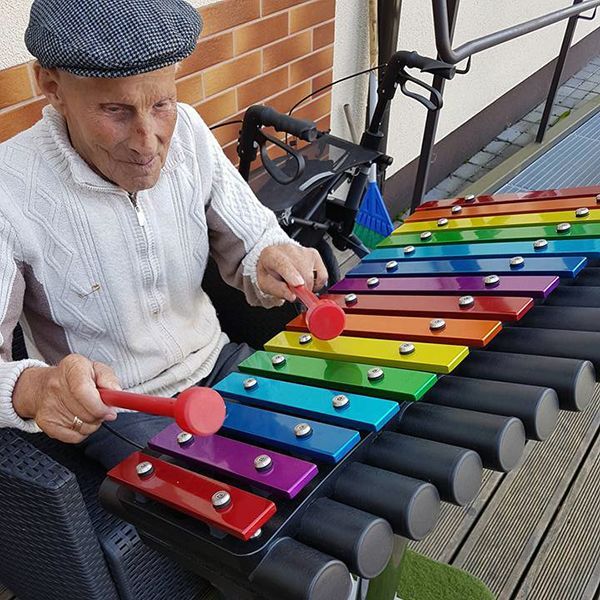
Music, in particular, plays a powerful role in this context. Outdoor musical instruments provide an intuitive, hands-on experience that encourages participation regardless of age, background, or ability.
Modern libraries are increasingly recognized as vibrant community hubs. They provide free access to resources, experiences, and opportunities that support lifelong learning and social connection. Outdoor spaces strengthen this role by:
An outdoor music garden or sensory courtyard can transform underused space into an active, engaging environment that complements indoor services.
Accessible outdoor spaces ensure that library resources can be enjoyed by the widest possible audience. Musical installations, in particular, are highly inclusive - requiring no prior experience and offering immediate engagement. Weather-resistant outdoor musical instruments also enable:
These environments support both structured programming and informal use, maximizing the value of library grounds.
Outdoor musical play offers a simple yet powerful way to bring people together. Making music in a shared space encourages:
For libraries seeking to strengthen their role within the community, these shared experiences are invaluable.
By clicking "Subscribe", you confirm that you have read and accepted our Terms and Conditions, Privacy Policy and Cookie Policy.